What are Brain Waves and What Do They Do?Written by Colleen Longua BCN-T, QEEG-T, ISF
What are Brain Waves?
We talk about brain waves a lot in the world of neuroscience and neurofeedback. But what are brain waves and what do you need to know about them? Let’s back up a bit. Our brain waves are made up of billions and billions of neurons that are all connected by brain highways (called synapses). Neurons use these synapses to send electrical signals (called action potentials) to each other to communicate with each other. These electrical signals are the basis for brain behavior, telling your neurons exactly what they need to do, helping you to move, think, feel, and function every day.
Our brains can send billions of action potentials every second. A single action potential is too small to measure in an EEG. When thousands of neurons fire together, it creates a signal strong enough that we can measure it. This is what creates your EEG. When enough neurons get together, they make waves that we can record, measure, and analyze.
You can think of brain waves like waves in the ocean. Some brain waves are very small like the waves on a beach on a calm day. Other brain waves are huge, like the waves that you would see during a storm. How big a wave is is called amplitude (measures in microvolts). Waves also travel at different speeds (measured in hertz). In general, faster waves will be much smaller than slower waves. How fast a wave is tells us what kind of wave we’re looking at and what its function is.
Delta (0-4Hz)
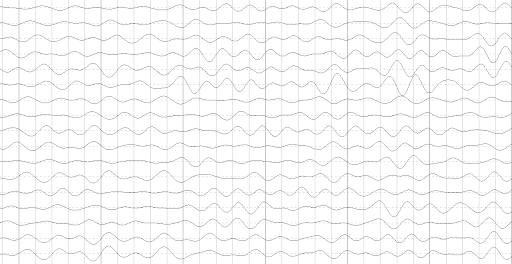
Figure 1 (delta waves)
Delta waves are the slowest waves that we record in an EEG. Delta waves are driven primarily by the thalamus. The thalamus is a deep brain structure that acts like a pacemaker for many of the rhythms of the brain. Delta waves are their largest during deep sleep and help our brains with things like memory consolidation, tissue and muscle repair, and physical and cognitive restoration while we sleep.
Too much delta activity during the day can indicate a head injury, ADHD, learning disabilities, or schizophrenia. Certain kinds of delta waves can also indicate structural damage due to lesions or encephalopathy. However, normal delta activity is important for keeping your brain healthy.
Theta (4-8 Hz)
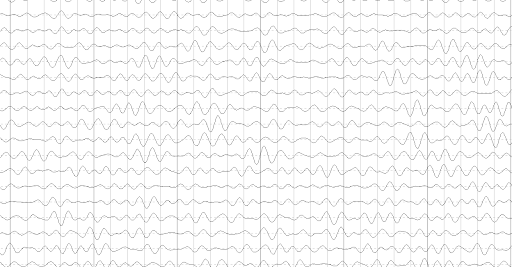
Figure 2 (theta waves)
Theta waves are slightly faster than delta waves and are also generated by the thalamus. Healthy theta activity is associated with early stages of sleep, imagination, empathy and creativity. Too much theta can indicate challenges with focus, impulsivity, learning disabilities and early childhood trauma. Theta activity can also increase during certain cognitive tasks. Theta can also increase with lack of sleep.
Alpha
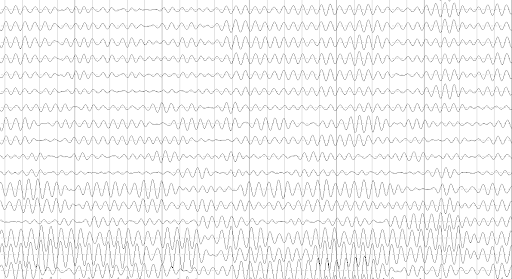
Figure 3 (alpha waves)
Alpha is one of the most important and well studied types of brain waves. Alpha waves can tell us a lot about brain activity. Alpha waves act as the brain’s “neutral gear” and are most prominent during states of deep meditation or drowsiness. Having too little alpha activity can contribute to anxiety or insomnia while too much alpha activity can lead to depression, negative rumination and brain fog. Healthy alpha activity allows us to feel relaxed and calm throughout the day and can also help with creativity and may even support memory.
SMR (12-15 Hz)
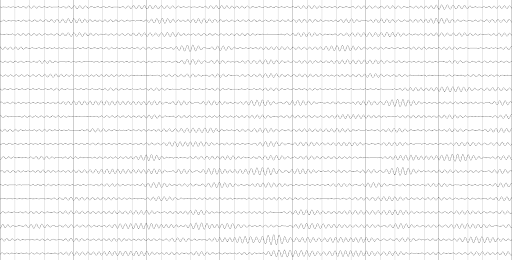
Figure 4 (SMR waves)
SMR, similar to alpha, doesn't fit the category of slow waves or fast waves. SMR (which stands for sensory motor rhythm) is a special kind of rhythm that is only seen along the sensorimotor strip. The sensorimotor strip is an area on the surface of our brains that helps with both our senses (touch, smell, sight etc.) and motor skills. SMR is associated with physical stillness and can also help with feeling calm, focused, and alert. SMR also acts as our brain’s natural anesthetic, helping us to stay asleep throughout the night.
Beta (15-40 Hz)
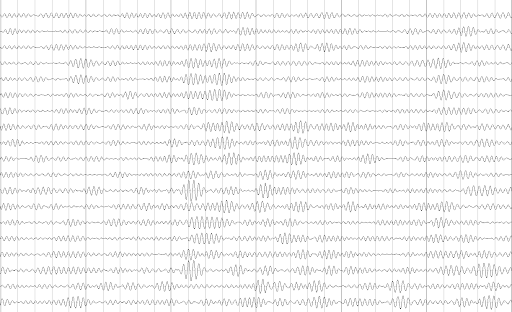
Beta waves cover a broad range of frequencies in the brain. Beta waves are split into two main types, Beta 1 and Beta 2. Beta 1 (15-20 Hz) shows up the most when we are
Figure 5 (beta waves)
feeling alert and focused and helps with learning, motivation, and problem solving. Beta 2 (21-40 Hz) shows up the most when we are concentrating very hard or when we are in high stress situations. Beta 2 helps us react to situations very quickly and is important for responding to immediate threats to our safety. Too little beta activity can make us feel lethargic, foggy, and distracted while too much beta activity can lead to feeling anxious, restless, agitated, and fatigued. Healthy beta activity helps us feel awake, motivated and connected with our surroundings.
Gamma (40-100 Hz)
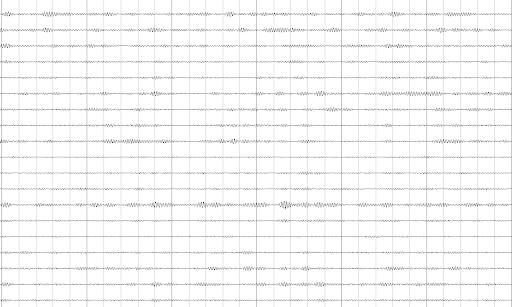
Figure 6 (gamma waves)
Gamma waves are the fastest frequency that we record in most EEGs. We are still learning about the role of gamma waves in the brain as they are so fast and often hard to see. What we do know is that gamma plays an important role in memory and consciousness. Expert meditators often have very high amounts of gamma activity in their brains. Gamma may also be involved in helping our brain’s circuitry function properly, acting as a binding rhythm for other brain waves.
All of our brain waves serve different functions and act in different ways. Too much or too little of any frequency can cause us to feel dysregulated. When our brain waves work together, they act like a symphony in the brain, helping us to sleep well, think well and feel well. If you are struggling with sleep, mood, or focus, it may likely be caused by your brain waves. Here at Mind Body Neuro, we work with your brain waves, helping the symphony to come back into tune so you can feel your best. Contact us today to learn more about how we can help you unlock your brain’s full potential.
References:
https://www.biosourcesoftware.com/post/a-deep-dive-into-the-delta-rhythm
https://pmc.ncbi.nlm.nih.gov/articles/PMC11214181/
https://www.verywellmind.com/what-are-alpha-brain-waves-5113721
https://pmc.ncbi.nlm.nih.gov/articles/PMC6456781/
https://pmc.ncbi.nlm.nih.gov/articles/PMC11578591/